Women’s Hair Transplant
Thinning parts, a receding female hairline or traction loss — performed without shaving the surrounding hair.
For women
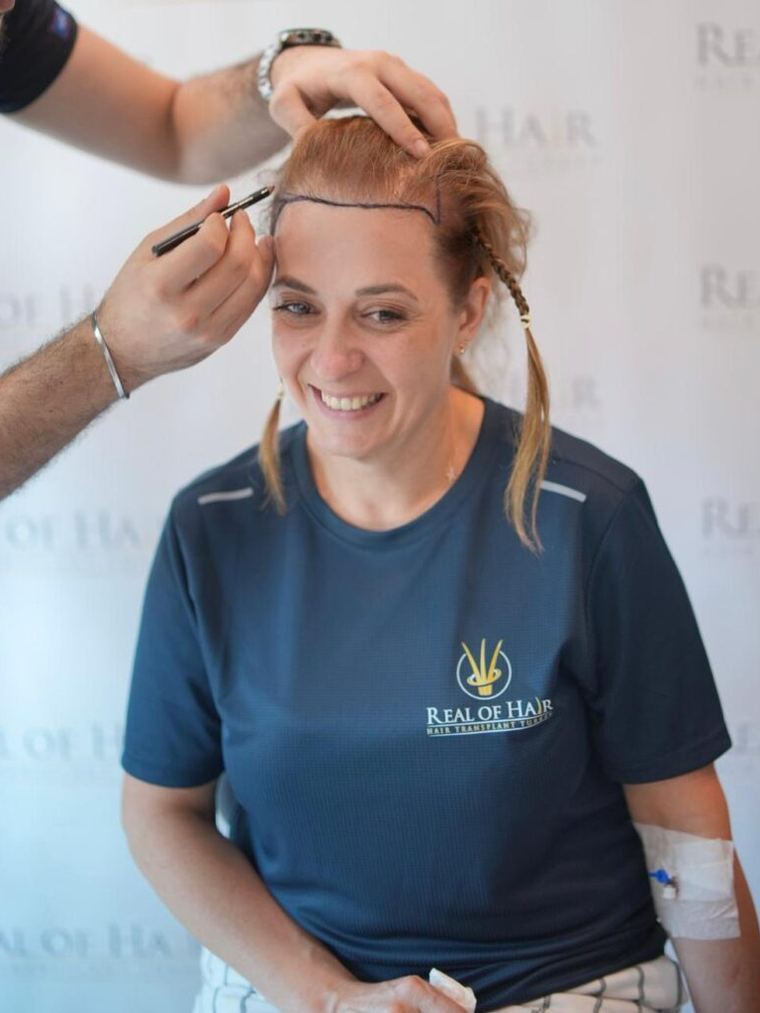
Thinning parts, a receding female hairline or traction loss — performed without shaving the surrounding hair.
Hair loss in women rarely follows the male pattern. More often it is a widening parting, thinning across the top while the hairline holds, or loss along the temples and edges from years of tension — braids, weaves, tight ponytails. That last pattern, traction alopecia, is common in Afro-textured hair and responds well to transplantation once the tension is removed.
The practical difference is that we work without shaving. Grafts are placed between existing hairs, and the donor area is harvested in a way that keeps it hidden under the surrounding length, so you can leave the clinic without an obvious sign of the procedure.
Female hair loss has many causes — hormonal, nutritional, medical. We establish the cause before proposing surgery, because in some cases treatment, not transplantation, is the right answer.
Donor units are taken selectively from beneath the surrounding hair, which is left at full length to cover the area.
A female hairline is rounder and softer than a male one. Where the parting is the concern, density is built along its edges.
Channels are opened carefully to avoid damaging the hair that is already there.
Mild swelling. Because nothing is shaved, most women are comfortable in public within a few days.
Shedding phase.
Regrowth becomes visible along the parting or hairline.
Final density. Styling returns to normal, with the caution that heavy tension should not return.
No. The procedure is designed to be done without shaving either the recipient or the visible donor area.
In many cases yes, provided the follicles are gone rather than dormant and the tension has stopped. If tight styles continue afterwards, the transplanted hair can be lost the same way.
Transplanting into an area that is still actively thinning risks a patchy result. We would normally stabilise the loss first, then transplant.
Yes, once healed. We would ask you to wait several weeks before chemical treatments and to avoid tight styles permanently.