Beard Transplant
Patchy growth, scars or a jawline that never filled in — mapped to your bone structure and placed at the sharp angles facial hair demands.
Precision
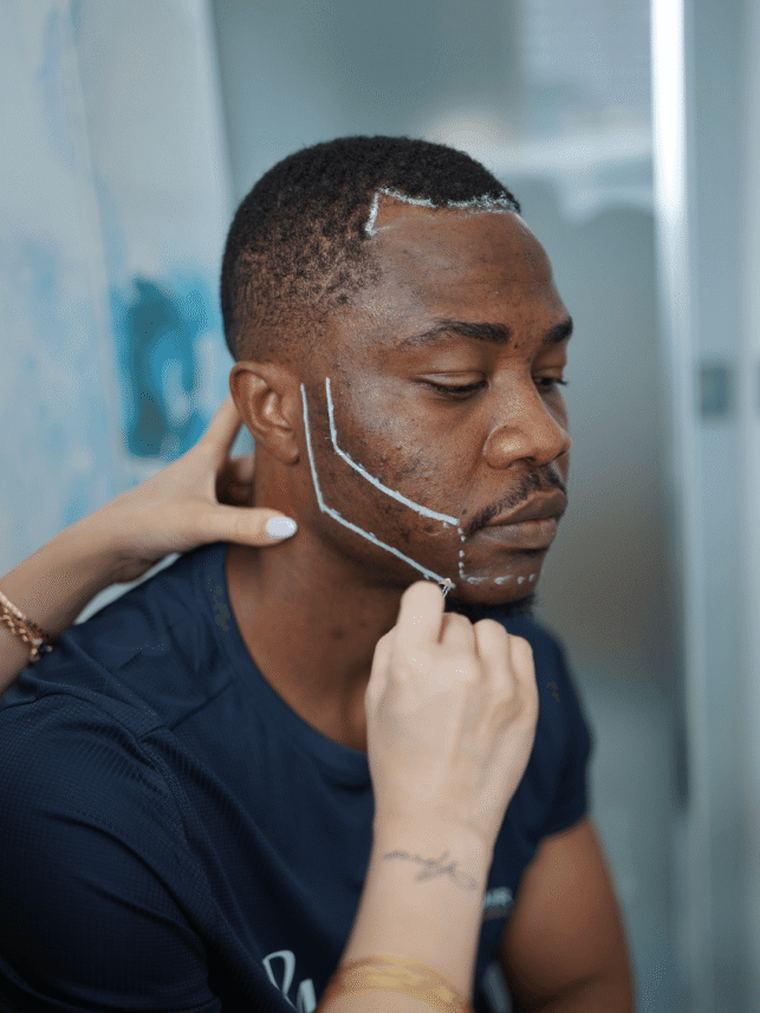
Patchy growth, scars or a jawline that never filled in — mapped to your bone structure and placed at the sharp angles facial hair demands.
Beard grafts come from the same permanent donor zone at the back of the scalp. The difficulty is not the extraction — it is the placement. Facial hair grows at a much flatter angle than scalp hair, and it changes direction across the cheek, jaw, chin and moustache.
Get the angle wrong and the hair stands away from the face instead of lying along it. That is why the design is drawn on your face first, following the line of your jaw rather than a template, and why each graft is placed individually.
The beard line is drawn while you sit upright, so it follows your actual bone structure and the way you hold your head.
Fine, single-hair units are selected — thicker multi-hair grafts would look wrong in a beard.
Sites are opened at an acute angle, changing direction across each zone so the hair lies flat.
Grafts go in one by one, with the finest hairs along the outer edges.
Small crusts around each graft. Most people take a few days before being seen.
Shedding phase.
Growth begins, first as fine hair.
Full density. You can shave and trim exactly as you would natural beard hair.
Yes, once healed. The transplanted hair behaves like the rest of your beard — it grows continuously and can be shaved, trimmed or styled.
Donor hair from the scalp is often slightly finer than facial hair. We select the closest-matching units and place them so the transition is gradual rather than abrupt.
A patchy cheek might need 800–1,200. A full beard design from a sparse base can reach 3,000. It depends entirely on the area and the density you want.
The entry points are tiny and close within days. Redness fades over two to three weeks, faster on some skin tones than others.